



Has it ever happened to you that you started watching a new TV series under Netflix’s ‘recommended for you’ list and were hooked or discovered a new artist recommended by Saavn or found a product that Amazon recommended made your life so much easier?
It feels like magic; like these people look into your mind to find out exactly what you want and give it to you in form of recommendations. Well, we know it’s not magic, or mind-reading, so how do these brands know exactly what you want to watch, or listen to, or buy?
It’s a little Digital Marketing trick called ‘predictive analytics’ and most companies, especially ones that depend on personalized content, use to give their audience content that is optimized to their liking and preferences.
What is Predictive Analytics?
The literal definition of the term ‘predictive analytics’ is: “…a range of analytical and statistical techniques used for developing models that may be used to predict future events or behaviors.”
Basically, it means you ‘analyze’ the past to ‘predict’ the future.
For this analysis, you leverage any past information that will help you develop your brand further. This includes, but is not limited to, statistical algorithm, data science, machine learning, and AI Techniques.
It’s kind of like a crystal ball that tells you the future, except you use actual, researched data to make educated predictions. And there is no crystal ball (sadly).
Step-by-step Breakdown of Predictive Analytics
Define the Project
It is important to define the project you’re using the predictive analytics for before starting the analytical process. This means you have to detail the project’s objective, what you want its outcome to be, what resources you’re willing to delegate to it, its budget, and scope of effort. Along with this, you will also have to identify the right data sets you want and need to use for the predictive analysis (in most cases, the answer is not “all”).
Deciding on the data sets to be used is important for various reasons. First, using too many unnecessary data will be a gross waste of resources. Secondly, using the wrong data will give you the wrong predictions and might lead you astray, not to mention the big dent it’ll cause in the budget to get yourself back on the right track.
Data Collection
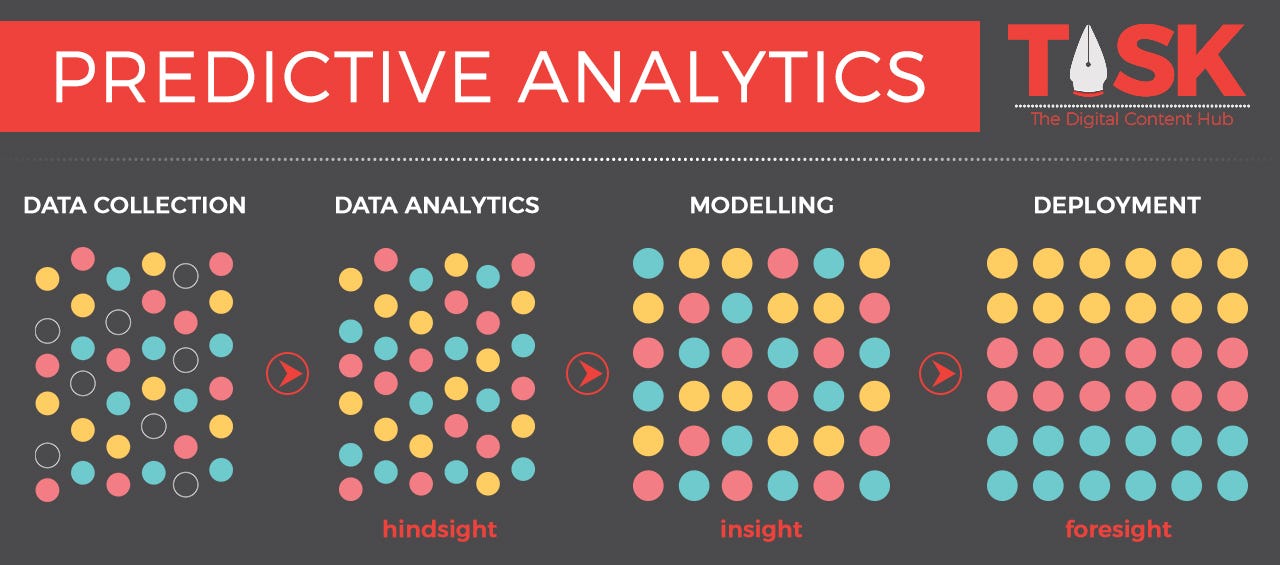
After figuring out what you’ll need, it’s time to start digging through your data, both physical and digital. Depending on the extent of the project, you can choose between just scratching the surface to going all out. What data mining does is it prepares data from multiple sources for analysis which provides a complete view of customer interactions.

Data Analysis
Once you have a cluster of all the information that you dug up in your mining process, you will have to analyze it and pick out — which means inspect, clean, and model — the data that is relevant to your project. This will help you arrive to conclusions and support your decision-making process, not only in this step, but in the entirety of your project.
Statistics
Remember when you decided what you want your project’s outcome to be? That is a hypothetical situation based on assumptions you’ve made about how the project will go.
Statistical analysis helps you validate these hypotheses and assumptions. Statistics and graphs may sound boring to go through, let alone make, but they are very important to the predictive analytics process. It not only enables you to validate the hypothetical areas in your project, but it also helps you make changes where needed.
For example, let’s assume you want to get outcome ‘F’ using resources A, B, C, and D in that order. Statistical analysis helps you either prove that the path you’ve mapped out is the best way forward or let’s you determine if you need to add resource E or remove resource D or switch the places of A and C.
This ensures optimum use of all your resources and saves you a lot on your budget (and avoids a lot more stress).
Modeling
With predictive modeling, you make and test models that will best help you predict the future of the market, your project, and the effect each has on the other. These models are based on the statistics you gather in the previous step.
Each of these models come with their own set of strengths and weaknesses, and it is up to you to decide which ones are most worth the effort and risk. Any model you chose needs to be reusable in all (or most) situations. For this, you need to create the model by training an algorithm using past data in a way that, once put to use, it will predict the near future without relying on said past data.
One of the bases of choosing a model is detection theory where the algorithm tries to guess the probability of an outcome given a set amount of input data, for example while deciding how likely it is for an email to be a spam.
Models can use one or more classifiers in trying to determine the probability of a set of data belonging to another set.
Deployment
Predictive model deployment allows you to ‘deploy’ your model and analytical results into your everyday decision-making process in order to automate it. Although it sounds easy, this step is a lengthy one that is full of challenges; sometimes it takes weeks, even months, to complete this stage, depending on the business scenario.
The challenges posed in this step include lack of integrated technical infrastructure (which makes it difficult to smoothly integrate the model throughout the different departments of the business), the data needed for the model deployment located in different data sources (increasing the time consumed in gathering the data), and the fact that the model needs to be installed into more than one application.
Monitoring
Most people treat monitoring as an afterthought; and that is where they go wrong. This step is more of an ongoing process that lasts the entirety of your project and is just as important to the predictive analytics process as any other step before it. When monitoring your predictive model, you need to make sure it is working as expected and giving the desire outcomes.
Predictive Analytics in Action
Major companies like Google, Twitter, Netflix, Saavn, Shaadi.com, and even Amazon use predictive analytics to bring personalized content to their audiences and give them satisfactory experiences. Let’s take a look at how they do this.
(Article continues below the infographic)

Google
Google uses your personal information from when you log in, your search history (yes, all of it), and your location and location history to give you ads it feels is relevant to you. It also uses this information to guess what search term you’re typing in and gives you auto-complete options.
Twitter
While using twitter, you will see some ‘sponsored tweets’ and some ‘suggested connections’. Sometimes you’ll ignore it and scroll past, but other times you will get to follow people who are highly compatible with your personality and retweet tweets that perfectly fit your account aesthetic. Twitter analyzes your usage history, you connections, and your retweet and like pattern to bring you these ‘sponsored tweets’ and ‘suggested connections’.
Netflix
Netflix has a whole list of movies and TV shows under their ‘recommended for you’ section, most of which you’ve never heard of but are definitely your ‘type’ and some that are going to change your life for the better (no exaggeration). To compile this list of recommendations, Netflix studies your streaming history and user ratings (the ones you’ve given and the combined ratings of all members that have similar tastes as you).
Saavn
This music app uses user ratings (again, yours and all members with similar taste) and your listening history to give you suggested music. It also compiles custom playlists based on the data related to you.
Shaadi.com
Shaadi.com is a matrimony site, so it goes without saying that it needs to personalize its content to suit every individual customer. The site analyzes your personal information, your partner expectation data, and your usage history and uses all this information to generate a list of matches it feels are the most compatible with you.
Amazon
There is a reason people prefer shopping on Amazon over going to a physical brick and mortar shop. When you shop on Amazon (in the comfort of your home), you get buying suggestions that you don’t get in even the biggest malls (that require you to actually endure the pain of dressing up and going out). To get you these buying suggestions (that you wouldn’t have discovered otherwise), Amazon takes into account your purchase history and deals/discount/offers data.
There, now you know how your favorite apps and sites bring you the exact things you are looking for. You’ve also learn how to use the ‘magic crystal ball’ called ‘predictive analytics’ to boost your own projects.
Predictive analytics, if used and monitored properly, has the ability to bring in huge success for your brand and get you the exact outcome you had envisioned in the beginning of the project. All you have to do is wield its power properly.
If you want any more help with predictive analytics, or any other aspect of Digital Marketing, do give us a shout!